
Environment
NITI
Aayog expert group suggests scrappage policy for thermal plants
·
An professional group
set up by NITI Aayog has adviser the creation of a thermal power plant (TPP)
scrappage policy during a bid to bring down the dependency of the ability
sector on coal and to maximise the use of clean and a lot of efficient energy
sources like renewables.
·
India has committed to
becoming carbon neutral by 2070 and to own five hundred Giga Watt (GW) of
renewable energy capability.
·
Coal-fired power plants
are normally decommissioned in India after their useful life of 30-45 years.
·
Coal accounts for about
72 per cent of India’s power supply as of 2021, while RE has been growing
rapidly to generate 10.7 per cent of electricity.
·
Around 40 per cent of
India’s greenhouse gas emissions can be attributed to 633 power units – 25 MW
and above capacity – operating at 189 thermal plants. Categories of Thermal
Power Plants In April 2021, the MoEF& CC amended the 2015 notification to
put coal thermal power plants under three categories.
·
The Union Ministry of
environment, Forest and global climate change (MoEF&CC) has discharged a
draft list of the coal thermal power plants and their categorisation in line
with the ministry’s Apr 2021 notification.
·
Coal thermal power
plants contribute to over half sulphur dioxide (SO2) concentration, thirty per
cent oxides of nitrogen (NOx), twenty per cent particulate matter (PM) within
the ambient air.
·
It
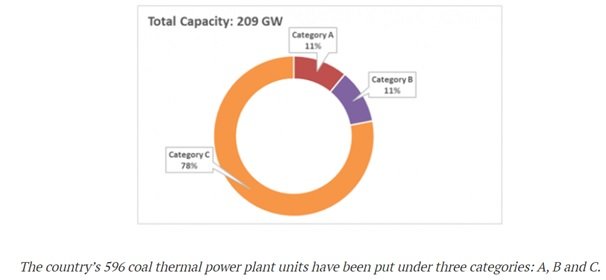
puts coal thermal power plant units into three categories:
Category Criteria Deadline for compliance A Within 10 km radius of the National
Capital Region (NCR) or cities having million-plus population 2022 B Within 10
km radius of critically polluted areas or nonattainment cities 2023 C Remaining
plants 2024
Comments